
The Power of Compounding Continues Through Retirement
Sometimes I get a little down, knowing that I didn’t invest much in the market while I was younger. I didn’t quite understand the power of compounding when it had so much more power to grow for longer.
Now that I’m in my mid 40’s, I’m not going to witness nearly as much growth as I would have had I started investing earlier.
However, recently I’ve been able to turn my thinking around and consider all the compounding left to go.
My Current Basic Retirement Strategy
I’m still thinking about how I’ll withdraw money in retirement, and I’m sure I may change slightly as I get closer. There are several approaches, but here’s a very basic way I’m currently thinking about allocation and withdrawing in retirement:
- X = how much we’re going to spend our first year of retirement (yet to be determined)
- Have ~28X (25X to 30X) saved up
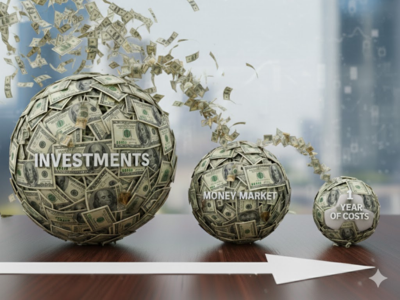
- Put ~3X (2X to 5X) in a high yield money market account, for spending
- Leave the remaining ~25X invested in broad based index funds
- Each year, move 1X (+ inflation) from investments to the money market account.
Let’s walk through this scenario with an arbitrary number:
- If X = $80K
- Have $2.24 Million saved up
- Put $240K in high yield money market account, for spending
- Leave the remaining $2 Million invested
- Each year, move 80K (+ inflation since retirment) from investments to the money market account
There are of course several other important factors that can change these numbers drastically that would need to be calculated, such as:
- Social Security
- Pension
- Tax implications
- Changes in spending
- Required Minimum Distributions (RMDs)
- More…
Ideally the invested amount will grow by more than 1X (+ inflation) every year, so that investments will actually grow beyond the 25X over time.
As I said, this is very simplified and just how I’m currently thinking about it. I’m sure my thoughts, tactics, etc. will change over time, and this is in no way advice for anybody else!
Considering Compounding
So, the simplified scenario above does rely heavily on investments growing over time, but unfortunately for my own way of thinking, doesn’t record all the compounding that will happen over a (hopefully) long rest of my life.
So I’ve started to consider a different way of making my brain happy seeing how compounding might work over time.
Saving for 100
Here’s my thought: even though the invested money is all together, what if I mentally imagined a separate account for each year that the money would be used for?
Before I withdraw the amount needed for the age of say 80, that money would have been invested and growing, and then moved over to the money market account at age 77, and eventually ready to use at 80.
So a very hypothetical question is: When I am 49, how much money could I set aside that would potentially meet my spending needs for when I’m 100 years old? It would be invested for 48 years, and then move over to the money market account for 3 years.
Let’s say that the rate of increase in today’s dollars (beyond inflation) will be 6% over 48 years, and that inflation and the money market account cancel each other out for the few years it waits from 97 to 100. Using the Rule of 72, the investments will double every ~12 years with a 6% return. With 4 doubles over those 48 years, we would only need to invest 1/16 of X.
- After year 12, the investment would grow to ⅛ of X
- After year 24, it would increase to ¼ X
- After 36, another double increases the investment to ½ X
- After year 48, we would arrive at X.
So, if I knew that my investments would beat inflation by more than 6%, then investing only 1/16th of what I’ll need in 48 years will produce enough for that year’s spending needs.
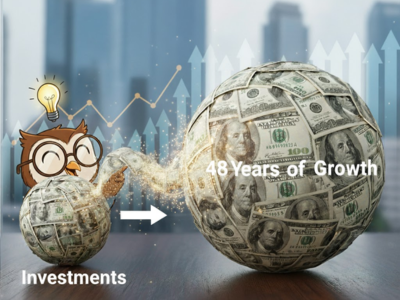
With these assumptions, if I’m anticipating spending $80,000 in today’s dollars and projecting returns of 6% above inflation every year, investing $5,000 for 48 years could produce enough for my 100 year old self. Wow, that’s pretty cool!
This Is Not A Plan
Of course we don’t know what the market is going to do, we don’t know future inflation numbers, and we don’t even know what money market rates will be. And we definitely don’t know exactly how much we’ll need to spend in 48 years from now… if we are even alive at that point in time. We also can’t only save up for the years we might live.
- We probably want something left when we’re dead, whether it’s to leave something for people or causes or something else.
- We might live longer than anticipated.
- We might have to spend more than anticipated.
In other words, this is a fun way to think about compounding, but not a plan.
Digging Deeper
Of course, like many other scenarios, it’s fun to go more into the rabbit hole. We could calculate how much to set aside for each year, and even go as far as physically creating separate funds for every single year during my and my wife’s withdrawal portion of our lives and monitoring them, and see if each year is on track.
Considering other factors for each year could be fun too. Putting a spreadsheet together allowing for changes to each year’s expected social security, pension, RMDs, tax implications, and changing costs and rates of returns could further enhance this way of thinking.
However, I don’t think I’m going to go that far at this point. Just understanding the basic concepts is what’s important to me right now.
Compounding Motivates
As you can see, I enjoy sharing concepts that I’m currently thinking through. This isn’t a prescription for something I or anybody else should follow. It’s merely fun thinking through these scenarios and concepts for myself and as I try to explain to others.
Right now I’m pretty happy thinking mentally through the first method I mentioned with targeted actual numbers as we get closer to leaving our jobs;
- Saving up 25X to 30X our expected spending
- Narrowing down what we want to be invested in
- Deciding how much we want invested and how much we want in money market or similar accounts
I’m always learning and being motivated in different ways. The power of compounding is one of the most important concepts that I’ve learned as it applies to investing, and I’m excited to learn and share more.
Links/Resources
Reader Questions
- How do you explain compound interest to others?
Leave your answers or comments below – or email us directly at info@epicfinancialjourney.com